Many of today’s essential medicines are made with ingredients derived from plants, but agricultural-based manufacturing of pharmaceutical ingredients can be unpredictable. The biotech company Antheia leverages advanced biosynthesis and biomanufacturing to produce critical pharmaceutical ingredients, reducing production timelines and costs, and ultimately creating more secure supply chains.
For over five years, the Advanced Biofuels and Bioproducts Process Development Unit (ABPDU) has been a key player in Antheia’s journey to bring its products to commercial scale. Antheia first partnered with the ABPDU in 2019 to leverage the facility’s fermentation and downstream processing capabilities. At the time, the company was preparing to launch its first commercial product, thebaine, a key ingredient in several essential medicines, including Narcan – a life-saving opioid overdose rescue drug.
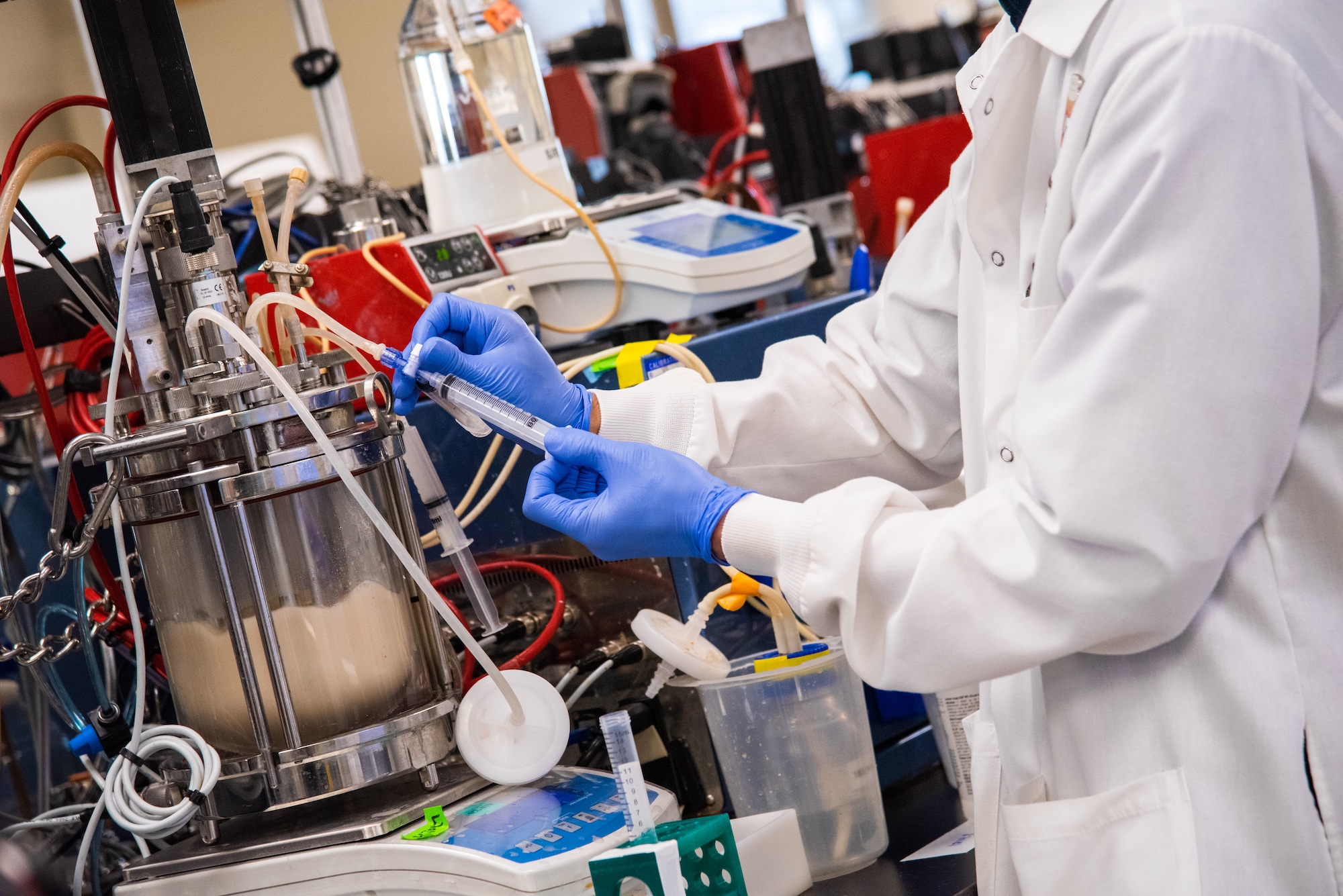
The Antheia and ABPDU teams collaborated on completing several pilot runs (small-scale trial productions) for thebaine, which ended up being critical for several reasons, said Antheia co-founder and Chief Scientific Officer Kristy Hawkins.
“First, these pilot runs generated representative material for customer sampling and quality and regulatory testing before scale-up,” Hawkins said. “Second, we better understood the sensitivities around thebaine production and could optimize both upstream and downstream parameters to make the process more robust. Lastly, these pilot runs validated that our process worked at a larger scale and gave us the data to confidently move to full scale manufacturing (around 100kL).”
The pilot runs required extensive planning and close collaboration between ABPDU and Antheia. The two teams worked together to ensure the runs went smoothly and to collect data for further optimization and scale-up.
“Antheia’s team knows exactly what their process requires, and they communicate this elaborately in a tech transfer document, which smoothens the transition from their site to ours,” said ABPDU fermentation engineer Kirch Czarina Quijano. “What stood out in this collaboration was the amount of time and effort our team and Antheia’s team dedicated to each campaign, as well as the brilliance and creativity of everyone involved.”
These were some of the most technically complex fermentations ABPDU has executed, said ABPDU staff scientist Eric Sundstrom.
“Antheia’s process itself was very complex, and it was at a near-commercial level, so everything had to be done at a very exacting standard to hit key performance metrics,” he said. “It has been a great experience for ABPDU’s team to execute processes up to that standard.”
The close partnership with ABPDU’s team led to the collaboration’s technical success, as well as the company’s eventual launch of thebaine at commercial scale, Hawkins said.
“Executing commercial scale runs at 100kL+ is prohibitively expensive and should be done only with certainty and confidence in the process,” she said. “Without ABPDU – and more broadly, without using pilot runs as an intermediate stage – we could have had a lot more difficulty scaling, and getting our products to customers could have taken longer.”
Antheia plans to continue pilot work at ABPDU as the company looks to bring more products to market and establish manufacturing operations in the United States. The company expects that the knowledge gained from partnering with ABPDU will streamline future product launches.
“We anticipate having to execute fewer runs for related products that are in development since we already have extensive insight into critical process parameters and sensitivities,” Hawkins said. “ABPDU has come to work as an extension of our team, and we continue to improve our processes with every run.”
This collaboration demonstrates how biomanufacturing can make an impact on domestic supply chains, Sundstrom said.
“We were able to act as a bridge between the lab and manufacturing-scale production,” he said. “This is a perfect example of how the flexible biomanufacturing infrastructure we’ve built at ABPDU can accelerate scale-up in new and unexpected applications.”
To further streamline this process, ABPDU is taking a “science of scale-up” approach to biomanufacturing, utilizing laboratory-scale testing under commercially representative, pressurized conditions to develop digital twins of 100K+ L capacity bioreactors.
The ABPDU, part of the U.S. Department of Energy (DOE)’s Lawrence Berkeley National Laboratory, enables early stage advanced biofuels, biomaterials, and biochemicals product and process technologies to successfully scale from the lab to commercial relevance. The ABPDU is supported by DOE’s Alternative Fuels and Feedstocks Office, formerly known as the Bioenergy Technologies Office.