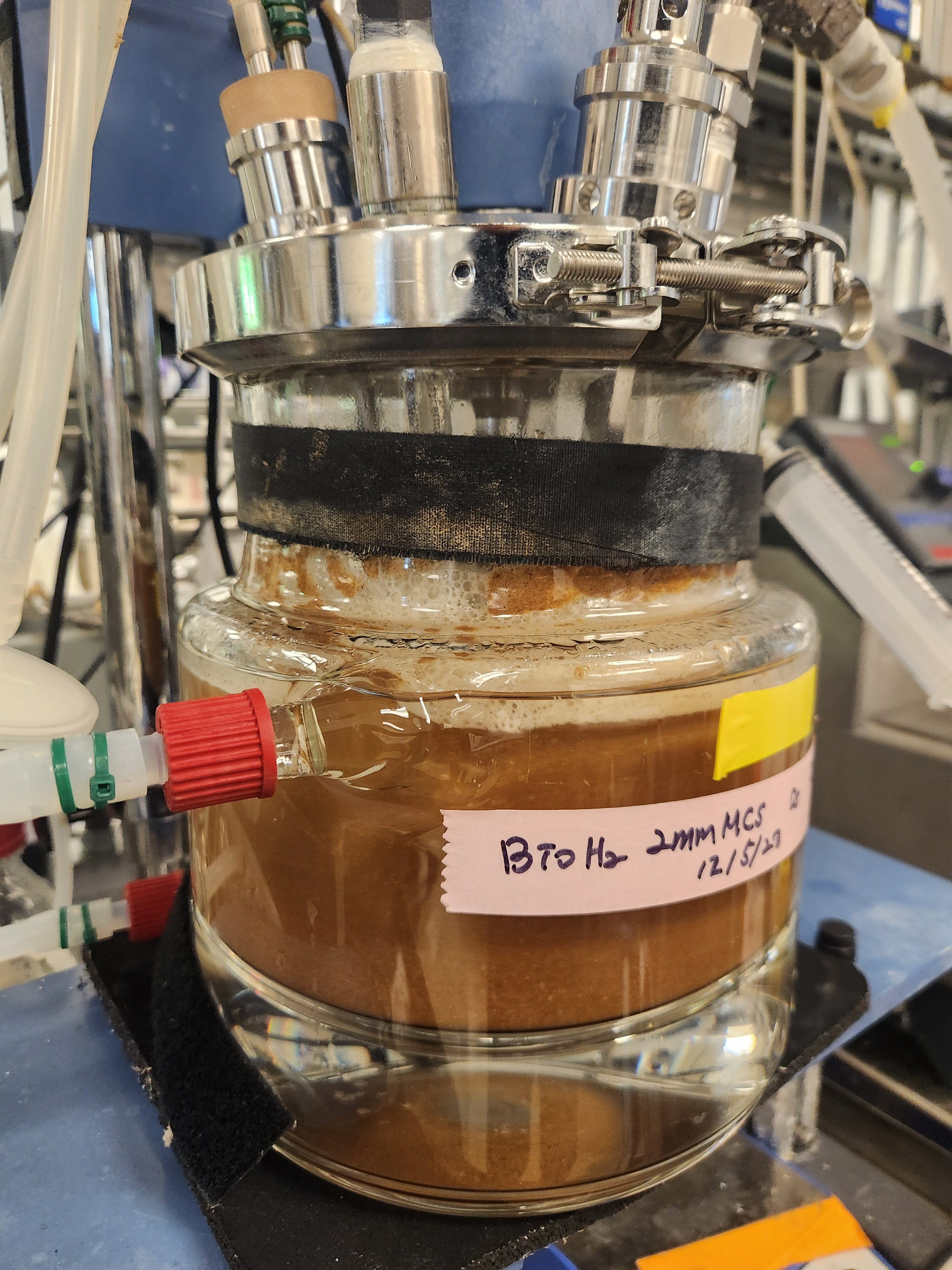
Biological hydrogen, or biohydrogen, is emerging as a promising bioproduct due to its value as both an energy source and as a component in various industrial applications, such as chemical manufacturing.
Researchers at the Advanced Biofuels and Bioproducts Development Unit (ABPDU) at Lawrence Berkeley National Laboratory are addressing key scale-up challenges facing biohydrogen production. Their latest research, published in Green Chemistry, has achieved a more than 50% improvement in biohydrogen production through a customized bioreactor system.
The research is a part of the BioHydrogen (BioH2) Consortium to Advance Fermentative H2 production, a collaboration between several national laboratories that aims to optimize biological production of hydrogen from waste biomass.
Producing biohydrogen from waste biomass is particularly appealing, as it not only makes use of biomass that would otherwise be burned or go unused, but it also generates products such as acetate and lactate, which can be used or converted to other products.
“This is an all-in-one waste disposal and energy generation strategy,” said Eric Sundstrom, a staff scientist at ABPDU and co-PI of the BioH2 consortium.
The consortium uses Clostridium thermocellum to convert biomass to biohydrogen, as the organism can break down biomass independently, without needing to add any external enzymes.
“Essentially, you just need to set the conditions in the correct way, add your organism and your preferred biomass, and let it go,” Sundstrom said.
This works well at low concentrations, but once the process is scaled up, yields start to drop. ABPDU’s role in the BioH2 consortium has been to identify the barriers that are causing this drop-off in performance and develop solutions.
“We realized pretty early on that you have to remove the hydrogen from the reaction really efficiently,” Sundstrom said. “If hydrogen builds up in the bioreactor, it pushes the reaction backwards and inhibits the production of more hydrogen.”
But when too much hydrogen is removed from the reaction, this also removes CO2, which is necessary to keep the reaction going. ABPDU researchers analyzed these factors and what approaches could maintain CO2 in the system while effectively recovering hydrogen.
“That got us to a good place, but we quickly realized that once you switch from model feedstocks to the real stuff, the mixing that we have in our bioreactors was just not good enough,” Sundstrom said.

When dealing with large amounts of biomass in a bioreactor, efficient mixing is key. In this latest work, the researchers used corn stover (stalks, leaves, and cobs that are left over after corn is harvested) as their biomass feedstock. They observed that the bioreactor’s standard impeller (a small rotating component) was unable to thoroughly mix the biomass. As a result, hydrogen built up in the bioreactor and the pH dropped, curbing production.
ABPDU bioprocess engineer Young Eun Song used computational fluid dynamics to simulate the optimal mixing conditions using large amounts of biomass, and used this to make adaptations to design bioreactors that are better suited for high solids mixing. These customizations allowed the researchers to control the pH and temperature, efficiently remove hydrogen, ensure the microbes have access to fresh biomass, and measure gas output.
These modifications were facilitated by an improved anchor-type impeller, which they found to be significantly more effective at mixing when compared with standard bioreactor impellers designed for low-viscosity applications.

Once these optimal mixing conditions were established, the researchers observed that at the highest solids loadings, the reaction would eventually self-poison as high concentrations of acetate are produced alongside hydrogen. To overcome this, Song developed a process for continuous operation of the bioreactor that resolves the issue of acetate buildup. This involves periodically allowing solids to settle, removing liquid, and then adding fresh biomass to the bioreactor as the process keeps running.
“This allows for the continuous removal of acetate and the ability to run the operation indefinitely, even with high amounts of biomass,” Song said.
Their optimized process utilized over 95% of the sugars present in the biomass and achieved a greater than 50% increase in biohydrogen production, setting a new performance benchmark.
Sundstrom said this proved there isn’t a fundamental biological limitation in biohydrogen production — rather, it’s the “science of scale-up” challenges that need to be addressed.
“The reaction can work fine. The question is, can you get the conditions right in the bioreactor, and can you sustain production for long periods of time?” Sundstrom said. “We’ve clearly shown here that the answer to that is yes.”
Moving forward, the ABPDU team will focus on scaling up this process further and adding additional modifications to make this as close as possible to a deployable commercial system.
The BioH2 consortium is supported by the U.S. Department of Energy (DOE)’s Hydrogen and Fuel Cell Technologies Office. The ABPDU is supported by DOE’s Bioenergy Technologies Office.